|

BANKING IN BOLIVIA
Tourism    Travel    Hotels    Airlines    Restaurants    Agents    Forums    Things to Do
Currency data courtesy coinmill.com
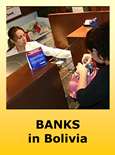
BANKING In Bolivia you can find the same range of services as you would in other regions such as the U.S. or Europe, with a few exceptions. Let me explain
currency
and
currency exchange
before we get into the services offered or not offered at the
banks.
This will make it easier to understand why in Bolivia you can open an account in either bolivianos or dollars, or both. ACCOUNTS In order to open an account as a foreigner you will be required to present several forms of I.D. (birth certificate, passport, etc.) as well as proof of your residency (carnet, and other documents), employment (employment contract and copy of your work permit from the Ministry of Labor), and business documents (if you own your own business your NIT and other documents). You must always present at least one form of I.D. when you withdraw money from your account.

CREDIT UNIONS are called “cooperativas” in
Bolivia
and function in a similar manner to
credit unions
in the U.S. Credit unions usually offer only savings accounts, although a few offer checking. They offer smaller loans to their customers, but with fewer requirements, making loans more accessible to the general public. However, their interest rates on loans are higher because of this as they are assuming more risk by requesting less information from their borrowers. Most also offer CD's and other services as well. Banks offer savings and checking accounts, CD's, credit cards and all types of loans. Most have ATM's in a good many locations throughout the city (as well as several branches). Most banks also have drive-thrus. Credit unions don't and did not initially have ATM's so they have fewer ATM locations. They also usually have fewer branch offices. Also, both sometimes have very small branch offices inside
stores,
like inside the Hipermaxi, Slan, and Fidalga grocery stores. NOTE ON ATMs. You can withdraw money at every ATM using a credit card; however, please be aware that you cannot DEPOSIT money at the ATMs yet in Bolivia. This must be done in person during regular business hours. NOTE ON CREDIT CARDS.If you have any trouble with your VISA or MASTERCARD, contact a company called LINKSER, found in the Yellow Pages to help you solve the problem. If you use AMERICAN EXPRESS contact MAGRITURISMO at 334-5663 (located on the corner of Potosí and Warnes streets). This is an AMEX travel agency with personnel on site to help solve any credit card-related problem you might have. Unfortunately DISCOVER is virtually unknown here and I have yet to find a store, restaurant or hotel that accepts it. These are both in Santa Cruz. PAYING YOUR BILLS In Bolivia you have to pay your bills for basic services and
utilities
(electricity, water, phone, cable TV etc.) directly at the company office (they do not mail out bills) and this can be inconvenient as you usually have to stand in line to pay, so banks and credit unions have arranged with those companies to accept payment of your bills and issue you a receipt (which these companies supply them) and turn the payment over to the companies. Therefore, you can pay your bills at your bank or credit union or one of its branch offices. MONEY TRANSFER Banks also offer
money transfer
services from your account to anywhere else in the world, or vice versa. In addition, Western Union and other agencies are present in several locations in Bolivia for direct money transfer. HOLIDAYS Businesses observe all national
holidays
as well as any “paros” called for by the city’s civic leaders (in protest to something, the entire city is shut down, schools and businesses are closed and usually all forms of
transportation
are also prohibited). And remember, church and state are not separate in Bolivia, so some Catholic holidays are national holidays. DEPARTMENTAL HOLIDAYS: They also observe departmental holidays, such as the date of foundation of each department. According to a new decree, departmental holidays will no longer be celebrated on the exact date of the holiday. They are to be celebrated on the first or last day of the week in which they occur (depending on which day they are closer to) to promote tourism on these holidays. BANKING HOURS Most banks observe the same work-day hours as most businesses in town opening Monday through Friday between 8:00 and 9:00 a.m. and closing between 5:00 and 6:00 p.m. Be aware that some also close their drive-thrus down at night for safety reasons, however their ATM’s are available 24 hours a day. They also close during siesta time (nearly all businesses do) which is usually at some point between noon and 3:00 p.m.
Businesses
also work on Saturdays, usually between 9:00 a.m. and noon. However, very few credit entities open on Saturdays. No one opens for business on Sundays, except
restaurants
and some open markets, as well as
tourist attractions
and
entertainment
centers (such as parks and movie theaters). I recently took photos of
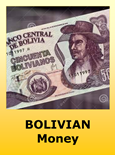
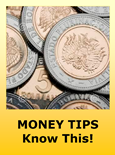
Bolivian money
so you can see what some of our coins and bills look like. In Bolivia each bill is a different color. This is helpful in a country where there is still a percentage of the population can't read words or numbers.
Return from Banking to Home Page


|