|
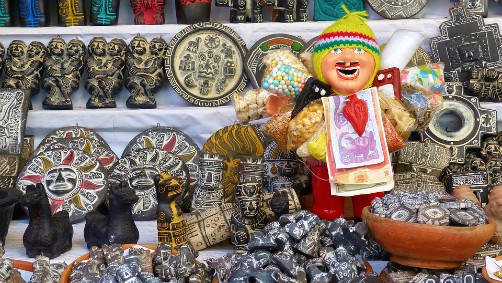
The Legend of the Ekeko In 1781, the indigenous peoples commanded by Tupac Katari rebelled against Spanish rule and put siege to the city of La Paz, where Paulita Tintaya, of Aymara blood, was handmaid to the wife of the governor and army commander of La Paz, Doña Josefa de Rojas. The girl was in love with another servant, Isidro Choquehuanca, also an Aymara, who had to stay at the master’s farm. Isidro had given Paulita an amulet consisting of a clay figure in the shape of Don Sebastian de Rojas, their master and father of Doña Josefa, who was a very short, fat, jovial and red-faced Spaniard.
After months of siege, people of La Paz were in a desperate situation, as food and water were scarce. They had to eat even cats and dogs so as not to die of starvation. Only in Paulita’s kitchen food was never lacking, thanks to the clay figure she had put in a little altar, which had miraculously provided the housemaid of enough dried meat, corn and biscuits. In reality, it was Isidro who had given her these provisions, as he was in the indigenous army and therefore able to secretly enter the city. https://youtu.be/LbWHCezxFwY When Doña Josefa got ill because of malnutrition, Paulita decided to share her food with her and the governor, who wanted to know where she had gotten it from. She told Governor Segurola that the clay figure, whom she called Ekheko, had the power to make food appear when needed, she did not want to put Isidro at risk of being caught and tortured. The whole house survived the long six months of siege thanks to Paulita’s food, and when the Spanish army sent a regiment to help the city, the indigenous army fled. Thankful for this "miracle", Governor Segurola and his wife gave their blessing to Paulita and Isidro’s wedding, taking them both into their house as servants. Neither of them ever forgot the little smiling man who had meant salvation to them during the hard siege, and created a little altar for him in their home. A long time later, people began to use imitations of this clay figure as a symbol of abundance, generosity and happiness. Today, people celebrate the Ekeko as the god of abundance in a yearly festival in La Paz that begins on the 24th of January called Alasitas. This festival is also celebrated in other regions of the country, such as Santa Cruz, where it takes place in September or October. Here people buy miniatures of everything they want the Ekeko to give them during the coming year and they pin the miniatures onto his poncho. Read more about this ritual here. Add Your Favorite Bolivian Legends    |