|
Bolivia Culture: Christmas in Bolivia In
Bolivia
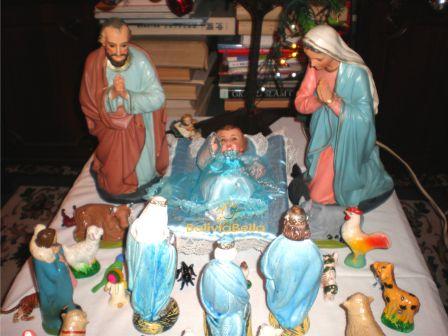
Christmas (Navidad) continues to be deeply religious, maintaining the original meaning and purpose of the holiday. Most families set up a “pesebre” (nativity scene) in their homes and
churches
usually have very large ones somewhere outside the main door. The word pesebre literally means "stable". Sometimes people call them "nacimientos" (nativity scenes).
Some Nativity scenes, especially at churches, consist of animals, shepherds, angels, a manger and baby Jesus, Mary, Joseph and the Three Kings (Wisemen) placed atop a bed of moss or straw or inside a stable. Others use real sheep, donkeys, and people. Many are small plaster or wooden figurines. Some make very large manger scenes with dozens, even hundreds of figurines.
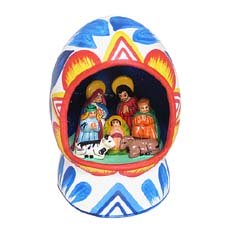
Sometimes gourds are hollowed out and painted brightly and the tiny toy nativity scene is placed inside. Paper maché is also used commonly to make colorful ornaments. However they are made, they are usually taken down on New Years Eve. Decorating the exterior of one's house is not customary here, nor is caroling from house to house. On Christmas Eve (Víspera de Navidad) church bells ring to call families to attend the “Misa del Gallo” a Catholic mass that takes place quite late at night, usually at midnight, and lasts possibly into the early morning (which explains the name: Mass of the Rooster).
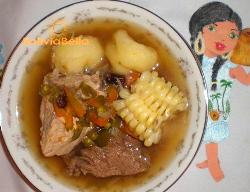
Families gather to feast together at midnight after Mass, others on Christmas Day. As these holidays takes place during the hottest time of year (summer in the Southern Hemisphere) meals usually feature picana, a soup made of chicken, beef, corn, spices and wine which is eaten traditionally on Christmas. The table is also set with salads, roast pork (lechón) or roast beef, and an abundance of tropical fruit. In Santa Cruz many people eat turkey or roast chicken at this time, similar to US Thanksgiving turkeys, although none of the other foods that accompany it are similar to an American Thanksgiving meal. For the same reasons, the table is often adorned with fresh flowers. At midnight the families toast with champagne or wine and eat taffy-filled wafer cookies called "turrón". Others drink a beverage similar to eggnog called cola de mono. Children sing "villancicos" - holiday songs. On Christmas morning it is customary to drink hot chocolate and eat buñuelos (a type of pastry drizzled with syrup). The “canastón” is another important Christmas tradition. A large gift basket, it is given by employers to their employees on the day prior to taking their vacation. The canastón is a simple, but usually large, basket (sometimes a plastic washtub is used), filled with basic food staples such as ketchup and mustard, bread, jam, crackers and cookies, sugar, rice, flour, and sometimes chocolates or candy. These canastones are almost never decorated, except for a clear plastic covering closed off with a large red bow. A “panetón” (a delicious traditional holiday sweetbread with raisins and nuts) and a bottle of “cidra” (sparkling cider, not alcoholic) are included. The canastón is important. Although an annual bonus (called an “aguinaldo”) and an annual raise are both required by law, it may be the only time an employer gives an employee any other type of bonus or incentive. On New Years Eve the family gathers again, feasts at midnight and toasts with champagne. One peculiar tradition is that each person must eat 12 grapes at midnight.
It used to be that families and friends did not exchange Christmas gifts. In Bolivia, gifts were given to children on Epiphany on January 6th, Día de los Reyes (Day of the Kings or Wisemen). Children placed their shoes outside the door with letters to the Wisemen who fill them with candy and pastries at night, much like the European tradition. Today most people have taken on the European and North American traditions of exchanging gifts at Christmas, although most do this after Christmas Eve dinner, around midnight, not on Christmas morning. On January 6th Catholic families take "Baby Jesus" from their nativity scene to mass at the local Catholic Church. They sometimes have their "Baby Jesus" figurine blessed by one of the priests or anointed with holy water. In some cities and towns, statues or figurines of the Baby Jesus and/or the Virgin Mary are also taken out of the churches and carried around the streets in a procession for all to see. 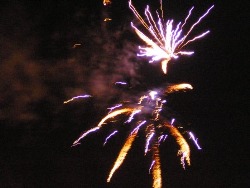
Perhaps the most unusual thing about Christmas in Bolivia is that exactly at midnight on Christmas Eve, all through the city fireworks are set off. It sounds more like the 4th of July or New Year's Eve in the U.S. and can last for up to an hour. The sky also lights up with "mata suegras" (mother-in-law-killers) which are tiny sticks of dynamite, slightly larger (and probably more dangerous) than the more traditional tiny firecrackers. There are no laws prohibiting the private sale of fireworks in Bolivia so imagine thousands of families all lighting up fireworks at the same time at midnight. More and more families are beginning to adopt the Christmas traditions of the American and European cultures (such as eating turkey, decorating a tree and house, or exchanging an abundance of Christmas gifts) but historically, these are not typical Bolivian Christmas traditions.     |