|
Camiri in Santa Cruz Bolivia Camiri is a small city of about 35,000 founded on 12 July 1935 in the southwestern section of the Department of
Santa Cruz
on the banks of the Parapetí River. Its name was originally Kaami (in the Guaraní language). It was then changed to Kaamichi, and eventually to its present name, Camiri.
Known as the Gran Chaco, this is a hot and arid region of dry forest savannahs and some rolling hills, mostly brushy vegetation and small trees, very little water, and surprisingly, quite a lot of flora and fauna species. Camiri is known as the oil capital of Bolivia because of the intense petroleum and natural gas exploration activities that are carried out here. Bolivia's government oil company, YPFB, has its national exploration and exploitation headquarters there and some of Bolivia's largest oil and gas reserves have been found in this area. Its people, known as “camireños”, are primarily of Guaraní and Spanish origin, although many Aymara and Quecha immigrants have settled in the area. Here the indigenous Guarani have been displaced by other peoples who came to the area after the discovery of oil in the 1920s. Most people here, especially the Guaraní, live in extreme poverty. It is said petroleum used to bubble up to the surface and the Guaraní tribes used it for curative purposes, as well as to light their fires. In 1926 petroleum spewed out from the ground and contaminated the Parapetí River. Soon after, Standard Oil Company was installed at this location and a town was “born”. After Standard was nationalized, the government took over operations and named the state-run oil company Yacimientos Petrolíferos Fiscales Bolivianos (or YPFB for short). When the country’s oil and natural gas industry was once again capitalized and opened up to foreign investment in 1997, the local population was motivated to improve hotel and tourist infrastructure in the area, several small companies that provided services to the oil companies sprang up, a branch of the UAGRM university in Santa Cruz was built, and the construction of a road from Abapó to Camiri was planned.
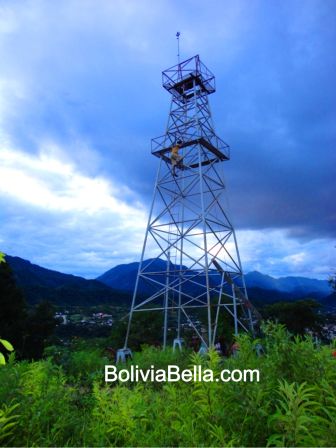
Camiri is one of the main stops between the city of Santa Cruz and the borders of Argentina and Paraguay. The highway between Santa Cruz and Camiri is paved and in excellent condition. The town has a sizeable bus station and buses run between the two cities daily. By car the trip takes 4 hours, by bus about 5 hours. The landscape along this route is pretty with many farms and cattle ranches. About two hours prior to reaching Camiri it changes from flat plains to hills and low mountains. Camiri was one of the sites where battles were fought during the Chaco War that took place between Bolivia and Paraguay (1932-1935). Just 8 kilometers from town visitors can enjoy the “El Chorro” waterfall. You can take a 2.5 hour tour where you walk about 7 Kms. through a pretty landscape. Nearby you can also visit hot springs and several other rivers and streams. There is no tourist infrastructure. It's more like a hiking and picnic day tour. Near Camiri you can visit Balneario Las Rosas, a natural place surrounded by exuberant vegetation and fruit trees. It's a small resort with a swimming pool located in Chorety. Phone: (591-3) 952-2906. Nearby is the Parapetí River. You can also visit some of the Guaraní villages near Camiri such as Itanambikua (7 Kms. from the city), Guasuigua (17 Kms. from the city), El Rodeo (18 Kms. from the city), Pipiparirenda (25 Kms. from the city), Urundaity (6 Kms. from the city), and Cañón de Segura (10 Kms. from Camiri), to see how members of the local communities live. Camiri also has two lookout points called "miradores" that overlook the city and surrounding hills and landscape. These are prime photo-taking locations. The city has a small main plaza surrounded by restaurants and stores. There are also several markets, bars and karaokes, banks and credit unions, pharmacies, internet cafés and phone centers.     |